Private-Label Pet Chews: A US Brand’s Sourcing Checklist
Private label lets a US brand own the shelf without owning a factory. Use this checklist to evaluate an overseas pet-chew supplier.
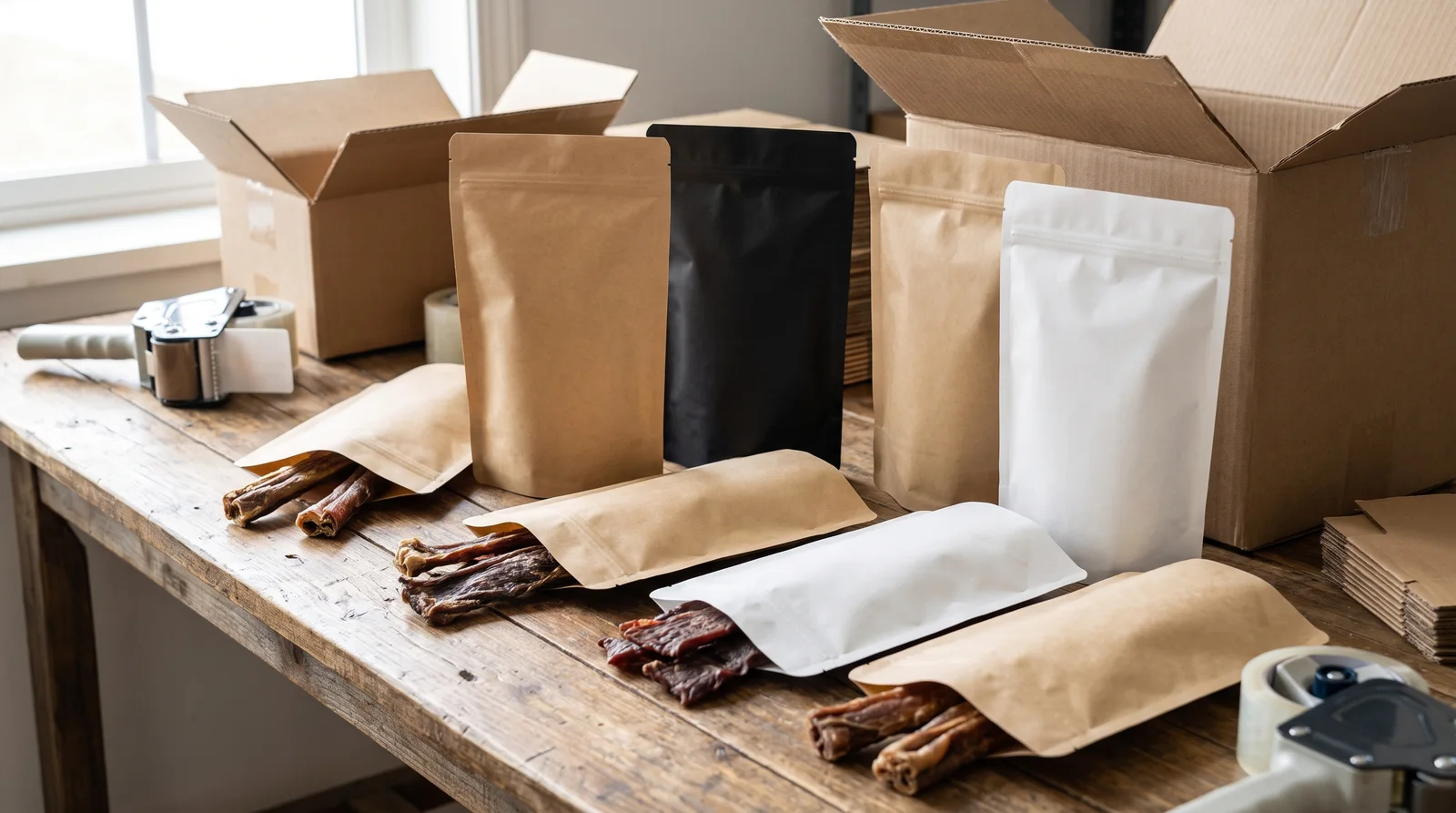
Private label lets a US brand own the shelf without owning a factory. It also moves responsibility for quality and compliance onto you, so the supplier you pick matters more than the price you first see. Here is the checklist we give buyers evaluating an overseas partner.
The checklist follows the order in which a private-label launch actually runs: define the product, prove it with samples, lock the label, agree on commercial terms, then confirm who handles the paperwork. Each section below can be used on its own as a step in your supplier review.
Start with single-ingredient clarity
The cleanest pet chews are one ingredient: beef pizzle, lamb skin, goat tripe, and so on. Single-ingredient products are easier to label, easier to defend to customers, and easier to clear at the border. Ask for the exact composition of every SKU in writing.
If you are still deciding on the range, our overview of types of natural dog chews compares the common formats. Start with three to five SKUs that cover different price points and chew durations rather than a long list you cannot test properly.
Get real samples against a written spec
A sample is only useful next to a spec: dimensions, moisture, protein, packaging and shelf life. Approve the sample, then hold production to that document. A supplier that ships to spec is worth more than one that ships fast.
| Spec item | What to write down | Why it matters |
|---|---|---|
| Raw material | Species, body part, origin | Drives the label, the APHIS permit and the customer promise |
| Size | Length or weight range per piece | Pack counts and retail pricing depend on it |
| Moisture or water activity | Target range and test method | Affects shelf life and mold risk |
| Guaranteed analysis | Protein, fat, fiber, moisture values | Must match what is printed on the label |
| Packaging | Pouch type, barrier, closure, carton count | Protects the product in transit and on the shelf |
| Shelf life | Months from production, storage conditions | Retailers and marketplaces ask for it |
| Testing | Tests per lot and laboratory | Supports safety and retailer onboarding |
How to evaluate a sample
Ask for samples from more than one production lot if possible. One perfect sample shows what the facility can do; two or three show what it usually does.
- Appearance: even color, no dark scorched spots, no visible mold or white bloom.
- Size consistency: measure ten pieces and compare against the spec range.
- Texture: the product should be fully dry for its type, without soft or tacky centers.
- Odor: natural chews have a smell, but a sour or rancid note is a warning sign.
- Packaging: check seals, closures and whether the pouch keeps air out after opening and closing.
- Paperwork: the sample should come with a spec sheet and, ideally, a test report for that lot.
Decide who owns the label
In private label the brand, artwork and responsible-party details are yours. Confirm the supplier prints to your approved artwork and does not slip its own branding onto the pack. The label is the part your customer actually sees.
Build the label to FDA rules and AAFCO model regulations, and include country of origin marking for imported goods. The dog treat label requirements checklist lists the elements to confirm before you send artwork to print.
Understand MOQs, lead time and logistics
Ask for minimum order quantities per SKU, production lead time, and how the goods ship. For animal-origin chews, the paperwork adds a few steps, so a partner that has exported to the US before will save you weeks.
Lead time for a first private-label order is usually longer than for a repeat order, because packaging has to be designed, approved and printed. Ask the supplier to split its quote into packaging lead time and production lead time so you can plan the launch date realistically.
Also ask how reorders work. A supplier that keeps your spec, artwork files and approved samples on record can turn a repeat order faster and with fewer errors than one that starts from scratch each time.
Confirm compliance is handled on the supplier side
The strongest arrangement is one where facility registration, origin health documentation and export paperwork sit with the supplier, and you manage the US entry. That is the model we run, so a US brand can focus on selling rather than on regulatory filings.
In practice that means the supplier provides its FDA facility registration details, the process description you need for the USDA APHIS import permit, and a veterinary health certificate for each shipment. You, as importer, hold the permit and work with a customs broker.
What a realistic first-order budget includes
The unit price on a quote is only part of the landed cost. When you compare suppliers, put every line below into the same spreadsheet so the comparison is fair.
- Product cost per unit or per kilogram, by SKU and pack size.
- Packaging: pouch printing, plates or setup charges, cartons and labels.
- Samples and sample shipping.
- Laboratory testing, if it is charged separately.
- Freight from origin to your warehouse, and insurance.
- Customs broker fees, duties and any port or examination charges.
- State registration fees where you plan to sell.
Ask your customs broker to estimate duties and fees for your specific products before you place the order. Duty depends on the tariff classification, so do not rely on a number from another product.
Questions to ask an overseas private-label supplier
- Can you share a written specification and recent test reports for each SKU?
- What are the MOQs per SKU and per pack size?
- Do you print my artwork, or do I supply printed packaging?
- How are lots coded on the pack and on the cartons?
- Which documents do you provide with each shipment?
- Have you shipped this product type to US importers before?
- How do you handle a lot that fails a test or is out of spec?
Red flags when comparing suppliers
- Claims of an “FDA approved” product. There is no such approval for chews.
- No written spec, or a spec that changes between quotes.
- Reluctance to share test reports or facility registration details.
- A price far below the market without a clear reason, such as a different cut or grade.
- The supplier’s own brand appearing on what should be your private-label pack.
How a private-label launch runs, step by step
- Shortlist SKUs and request a quote with specs.
- Order and evaluate samples against the spec.
- Finalize the spec and sign off on the commercial terms.
- Design and review the label, then approve the print proof.
- Apply for the APHIS permit and confirm the document pack.
- Produce, test, pack and ship the first order.
- Clear US entry through your broker and track sell-through before reordering.
You can see the product groups we supply on the natural chews page.
Frequently asked questions
What is the difference between private label and white label here?
In practice both mean the product ships under your brand. Private label usually implies you also influence the spec and packaging, which is what we recommend so the product matches your positioning.
How small can a first order be?
Most buyers start with a trial or a single pallet to validate the market, then move to container volumes. Minimums vary by SKU and are confirmed in the quote.
Who is the responsible party on the label?
For a private-label brand it is normally you, the US seller. We print to your approved artwork and responsible-party details.
Can I mix several SKUs in one shipment?
Usually yes, as long as each SKU meets its own minimum and is covered by your APHIS permit. Mixed pallets are a common way to test a range before committing to full containers.
Who pays for samples?
Terms vary by supplier. Many charge for samples and shipping and credit the cost against the first order. Ask for the sample terms in writing with the quote.
Can I change the spec after the first order?
Yes, but treat it as a new spec. Re-approve samples, update the label if the analysis changes, and check that your import permit still covers the product.
Talk to a supplier, not a broker
Tell us your product group, target market and volumes, and we will come back with a quote and the compliance steps that actually apply.
Request a quoteThe US-facing pet line of Export Partners LLC. Wholesale and private-label functional chews, natural dog chews and freeze-dried treats, sourced in Turkiye with FDA and USDA compliance handled on the supplier side.
Leave a Reply